CONBO-MAR
Basis for Mediterranean macroalgal forests conservation: prospecting, fragmentation, biodiversity, and recovery capacity for management strategies design.

The overall objective of CONBO-MAR is to study the conservation status of shallow marine forests dominated by Cystoseira s.l.,their capacity for recovery and their specific drivers of change, and to propose effective tools and strategies for their conservation.
Keywords: canopy forming macroalgae, marine conservation, marine ecology, fragmentation, biodiversity, recovery capacity
CONBO-MAR is an interinstitutional project funded by Ministerio de Ciencia e Innovación and la Agencia Estatal de Investigación num. PID2023-150997OB-100
Which are the main objectives of the CONBO-MAR project?
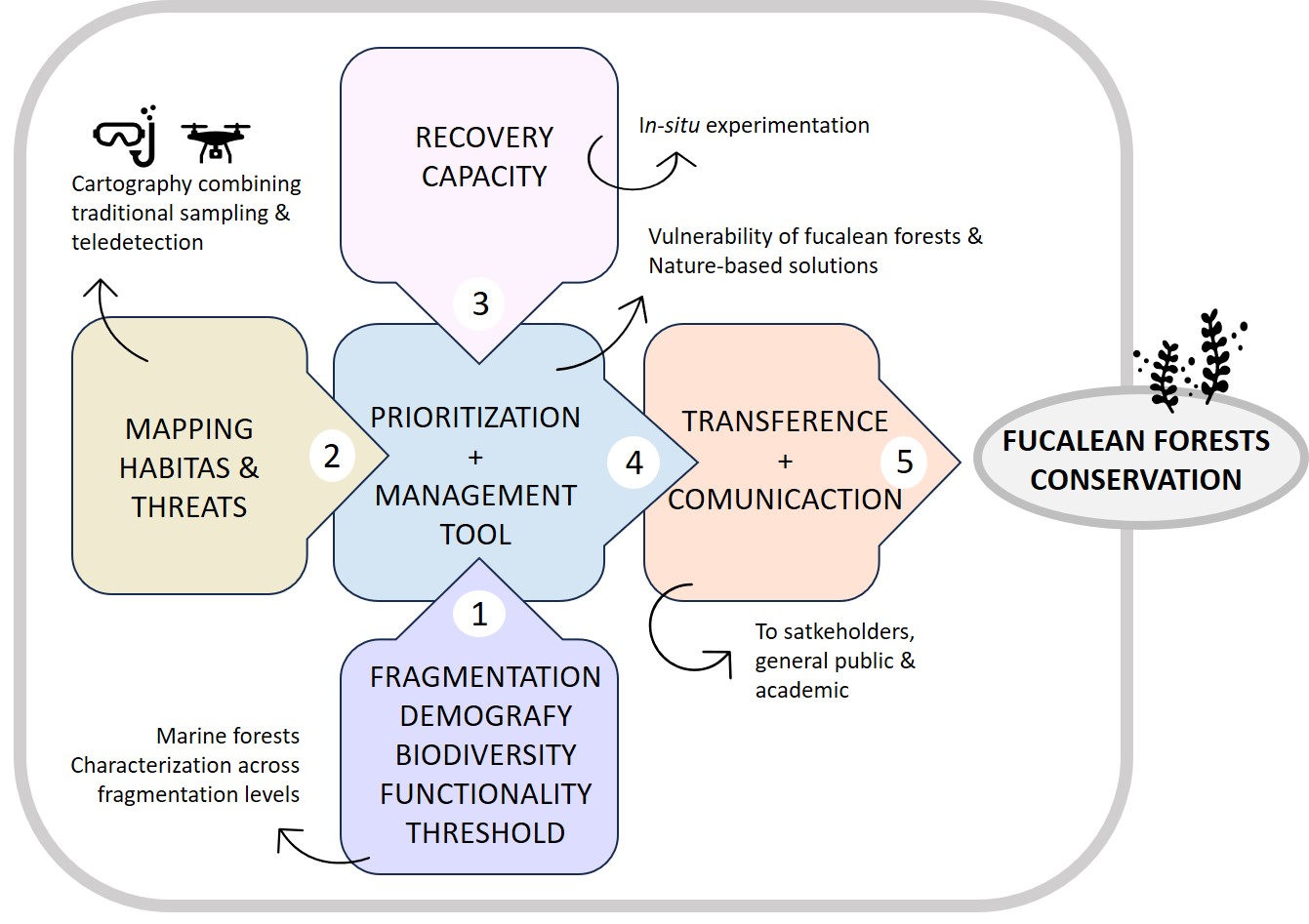
CONBO-MAR aims to study the conservation status of shallow marine forests dominated by Cystoseira s.l., their capacity for recovery and to propose effective tools and strategies for their conservation according to the specific drivers of change. The project is divided into 4 main objectives:
In short, we have seen that impacts of local stressors strongly depend on both species specific and life stage vulnerability to the different stressors. Overall, early life stages are more vulnerable to slightly pollution stress and climate change impacts, compromising the viability of the already threatened populations at mid-long term.
How does macroalgal forest functionality change with fragmentation?
High habitat fragmentation often indicates poor conservation status and potential ecosystem collapse. To assess the conservation status of macroalgal forests, factors such as density, size structure, physiological variables and overall ecosystem function will be analysed at different stages of fragmentation. We want to identify thresholds for the persistence of fucal forests based on fragmentation and key biological parameters to help guide conservation efforts.
How can we effectively identify fragmentation and impacts on marine forests?
Identify the key biotic and abiotic factors affecting Cystosseira s.l. populations is crucial to prevent marine forests loss. This project aims to use different methods (satellite imagery, drones and field sampling) in pilot areas to analyze the fragmentation of these forests and the local and global pressures affecting them.

What is the recovery capacity of Cystoseira forests?
Research has shown that different Cystoseira s.l. species exhibit varying levels of responses to stressors (such as high temperatures, pollutants, and overgrazing). These responses are often species-specific and related to the life traits of each species. In fact, current projects like FORESCUE and FORESTA are advancing our understanding of macroalgal forest vulnerability to various impacts. Here we want to study the recovery capacity of these forests after disturbances by assessing the Cystoseira s.l. forests ability to return to pre-disturbance states.
Therefore, we will investigate the recovery capacity of a forest after impact removal (e.g. overgrazing by seaurchins) and also, we will study the recovery capacity depending on surrounding habitat type (e.g. turf, barren).
How can we contribute to the conservation of these Mediterranean marine forests?
Integrating these previous findings on marine forest fragmentation, its functional and resilience consequences, and impact assessments from pilot areas, we aim to identify priority conservation zones and explore potential local and regional remediation strategies.